The Hoover Dam Is In Trouble, And Lake Mead Is On All-time Low
Posted: August 10, 2026
Updated: August 10, 2026
-
Lake Mead is drying out
-
How to bet on world props online?
-
The Hoover Dam is in trouble.
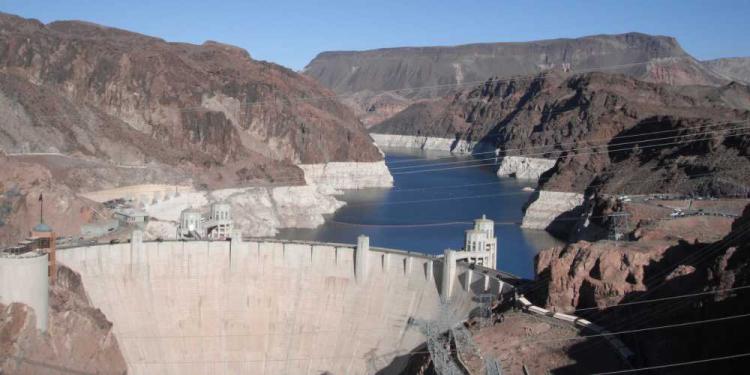
The Hoover Dam is in trouble, and the numbers behind Lake Mead’s record-low water tell the whole story.
The Hoover Dam is in trouble. Lake Mead just dropped to its lowest level since the reservoir first filled nine decades ago. Federal officials are scrambling.
Western states are fighting over what’s left of the Colorado River. Meanwhile, a ghost town has crawled back out of the mud. This piece breaks down what’s happening, why it matters, and what could come next. Register with any online sportsbook in the US to find odds on world events!
The Hoover Dam Is In Trouble By The Colorado River
According to the Review Journal, the Trump administration is already trying to come up with a plan to tackle the Colorado River problem. It’s a 10-year framework. Under this plan, states could face mandatory cuts. California, Arizona, and Nevada might need to reduce their combined use by up to 3 million acre-feet a year. That’s nearly 40 percent of their total allotments. However, the administration isn’t going straight for the harshest option. For the first two years, it’s accepting a softer deal the three states proposed themselves. That deal trims about 3.2 million acre-feet through 2028, roughly half the maximum cut.
Why does any of this matter to a dam built in the 1930s? Because the entire system runs on a promise made in 1922. The Colorado River Compact divided up the river’s water. Unfortunately, that agreement overestimated how much water the river actually carries. Since 2000, drought and rising temperatures have shrunk the flow dramatically. Therefore, the math behind the original deal simply doesn’t work anymore. States upstream and downstream disagree constantly about who should absorb the pain. Register at Bovada Sportsbook to bet on prop markets!
Lake Mead Is On An All-time Low
The Hoover Dam is in trouble for many reasons. Lake Mead holds many secrets, and right now, it has reached an all-time low, revealing much of Nevada’s great history. On August 8, the reservoir hit an elevation of 1,040.34 feet. That’s the lowest reading since the lake was first filled in the 1930s. It edges out the previous record set in July of 2022. Federal data puts the lake at just 26.8 percent of capacity. Storage sits around 7 million acre-feet, well below the basin’s historical August average. Over the past year alone, the surface has fallen nearly 14 feet.
That’s a steep drop for a reservoir supplying more than 20 million people. Jack Schmidt, who studies the Colorado River at Utah State University, called it uncharted territory for the entire basin. He’s not exaggerating. A weak winter snowpack drove much of this decline. Heat and prolonged drought did the rest. Because Lake Mead sits downstream from Lake Powell, problems upstream ripple straight through to Nevada and Arizona. Southern Nevada still draws most of its water from Mead, so this record carries real weight locally.
The Hoover Dam Is In Trouble: Ghost Town Appeared
According to SF Gate, the founding town buried beneath Lake Mead has appeared and is fully ready to be discovered on foot. Foundations, glass fragments, and old cisterns now sit in plain view along a short walking trail. Visitors can wander the ruins on foot, and the National Park Service maintains interpretive signs along the route.
It’s an eerie contrast, honestly, walking through a drowned town while standing on dry, cracked earth. The site draws hikers and history buffs alike, curious about a settlement swallowed by progress. Still, park officials warn against disturbing anything found there, since it counts as a protected archaeological site. Ironically, the same drought threatening the region’s water supply is what makes this walk possible.
Can It Lead To An Electricity Shortage?
Las Vegas’s electric infrastructure is growing, yet the Hoover Dam’s issues can cause a break in cheap electricity production. Thus, making sure that the Dam is still capable of producing electricity should be a big concern, even if it won’t be ruined in one day. Federal officials have flagged 1,035 feet as a critical threshold. Once the lake falls below that mark, generating capacity could drop by as much as 70 percent. That’s when the Hoover Dam is in trouble for real. It’s a serious blow to a power source millions of homes rely on. Utility managers in rural Nevada have already warned customers about rising rates. One official from Lincoln County Power told reporters that decades of cheap hydropower may simply be ending.
Grid specialists are now modeling worst-case scenarios to prepare for reduced output. Some of those scenarios stretch into next spring, when levels could fall even further. Because Hoover Dam has powered the Southwest for ninety years, this shift feels significant to longtime residents. Meanwhile, demand across the region keeps climbing, driven partly by data centers and rapid population growth. Boulder City, notably, has pushed back against new data center proposals for exactly this reason. So even though the dam won’t fail overnight, its electricity output is already under real strain.
The Hoover Dam Is In Trouble: Approaching Dead Pool
According to Popular Mechanics, under 3,370 feet is the threshold for dead pool, where gravity could no longer aid the water in escaping the reservoir. At the moment, Lake Powell rests at an elevation of 3,528 feet. This isn’t that much away from the dead pool level. Lake Mead’s dead pool sits at 895 feet, far below its current elevation near 1,040 feet. On paper, that gap looks reassuring.
Yet these two reservoirs don’t operate independently. Whatever happens at Powell eventually affects how much water reaches Mead. Because the entire Colorado River system is interconnected, a crisis upstream doesn’t stay upstream for long. Engineers describe this middle zone, between minimum power pool and dead pool, as the most dangerous stretch. Water can still pass through, but hydropower stops completely in that range. If snowpack fails again next winter, both reservoirs could inch closer to these thresholds simultaneously.
Can You Bet On The Water Level Of The Hoover Dam?
While we can’t do much with the fact that the Hoover Dam is in trouble, we can at least bet on it. The Hoover Dam is one of the biggest elements in Las Vegas’s history. If the government can’t solve the problem, we suspect it will become a prediction market or a poly-market bet. Nobody knows exactly how fast the lake will fall, or whether next winter’s snowpack will offer any relief. Water managers publish monthly projections, yet those numbers shift constantly based on weather patterns nobody can fully predict.
That unpredictability is precisely what makes speculation, formal or informal, so tempting to some. For now, the more practical story remains the ongoing negotiations among states, tribes, and federal agencies. Their decisions will shape water deliveries, electricity costs, and even tourism around the dam itself. Thus, it makes for the best prediction markets. Register at Bovada Sportsbook and place a bet on world events online!
Click here to stay tuned with Bovada Sportsbook!


GAMBLING NEWS IN UNITED STATES


2026-09-24

2026-09-24

2026-09-24

2026-09-23

2026-09-23

2026-09-22
