A Complete Guide to the Math Behind Blackjack
Posted: March 10, 2026
Updated: March 10, 2026
You can play blackjack and still have a great time without understanding what you're doing. In other words, simply relying on luck. However, once you have a better understanding of the math behind blackjack, your winning chances go up exponentially.
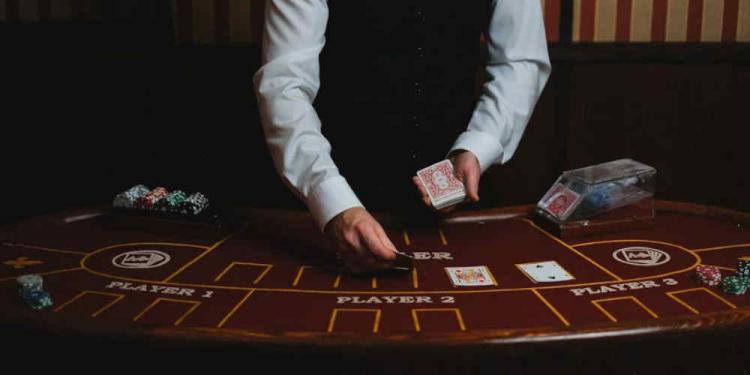
Image source: Pexels
The Importance of the Math Behind Blackjack
We’ve all sat at a casino blackjack gaming table, feeling that nervous buzz in our chests. You see the dealer pull an Ace, and suddenly your hand feels very small. To be honest, we’ve been there ourselves many times. Although most people think it’s all about luck, that’s not quite true. In blackjack, there’s a deep, logical structure to every hand you play. Here at Gamingzion we want to help you see the game through the lens of numbers. This will allow you to play with more confidence. To that end, this article explores the math behind blackjack to help you keep your cool when the cards start flying.
Why the Math Behind Blackjack is a Mathematical Outlier
Blackjack is a rare beast in the world of gambling because, unlike so many other games, it’s more of a game of memory. Most games like craps or roulette start fresh every single time you play, either by throwing the dice or spinning the wheel. In truth, a dice roll doesn’t care what happened five minutes ago. But in the game of blackjack, the deck remembers. If four Kings are on the table, that means they aren’t in the shoe anymore. That single fact changes everything for players. You’ll find that once players grasp this, the game feels much less like a mystery. In fact, it’s the math behind blackjack that makes it beatable. However, you need to have a solid plan.
The Fundamental Law: Independent vs. Dependent Trials
At this point we need to talk about why some events depend on others. Now imagine a bag with one red ball and one blue ball. If you take the red one out, then the next pick is guaranteed to be blue. This is a dependent trial. Blackjack works exactly like that bag of balls. It means that every card dealt changes the odds for the next person. We’ve noticed that new players make a basic mistake of ignoring this fact and treat every hand as a brand new start. You’ll quickly find out the math behind blackjack relies on the fact that the “shoe” is constantly evolving as cards leave the deck.
Probability Basics: The Composition of a Standard Deck
OK, let’s look at some mathematics. To start with, a standard deck has 52 cards, with 16 of those having a value of ten. That’s nearly a third of the entire deck. Because of this, we always assume the next card coming off the top is a ten. We believe it’s the safest way to think when you are unsure. If you see a lot of low cards on the table, that means the deck is now “rich” in tens. You can use this simple observation to stay in the game longer during your sessions. Understanding the math behind blackjack starts with knowing these basic ratios like the back of your hand.
Defining the House Edge: The Math Behind Blackjack
As you’re well aware, the house has an advantage. This is because you have to act before the dealer does. As a result, if you bust, you lose your money immediately. It doesn’t matter if the dealer eventually busts too. In some ways, you can look at this as the “hidden” tax on your play. Yet by using the right strategy at online casinos like 22Bet Casino, we can shrink this advantage down to almost nothing. On the other hand, without a plan, you’re giving the casino a much bigger slice of your money. We’ve seen many new players lose fast because they didn’t respect the math behind blackjack and played on nothing more than pure “gut” feelings.
The Anatomy of “Natural 21” and Math Behind Blackjack
To be honest, getting an Ace and a ten-value card on the start is the best feeling. This so-called “Natural” usually pays out 3 to 2. So, if you bet $10, you’ll get $15 back. Beware that some tables only pay 6 to 5 now, which is a total rip-off. We always tell our friends to avoid those tables at all costs. Keep in mind that a 6 to 5 payout nearly triples the house edge against you. You can check online casino news in the US to find which sites still offer the good 3 to 2 payouts. The math behind blackjack shows that it’s these bonuses that can help to keep your bankroll healthy.
Expected Value (EV) in Every Decision
Expected Value is just a fancy way of saying “what will happen on average.” If you make a move a thousand times, will you end up with more money or less? As a rule, you should only try to make moves that have a positive or neutral EV. For example, standing on a 20 has a very high EV. But conversely, hitting on a 20 has a terrible EV because you will almost always bust. Here at Gamingzion, we’ve spent hours looking at these numbers to make sure our choices are sound. Remember that the math behind blackjack is really just a collection of these high-value decisions.
The Math Behind Blackjack: Basic Strategy
Basic strategy in blackjack is not a suggestion you can simply take or leave. It’s actually a mathematical map that was created by computers. They ran cycles of millions of hands to find the best move for every situation. Luckily you don’t have to be math geniuses because the hard work has already been done for you. We just need to follow the blackjack strategy chart. If the chart says hit, then you should hit. If it says stand, then stand. It’s useful in that it takes the emotion out of the game. When you use the math behind blackjack through a blackjack strategy card, you’re playing at the highest possible mathematical level.
The Impact of Rule Variations on the Margin
Always consider how small rules can change your odds quite a bit. For example, if the dealer has to hit on a “soft 17” (an Ace and a six), the house gets a bit stronger. On the other hand if you’re allowed to double down after you split your cards, that helps you out. Before we sit down to play, we like to look for games that have the most player-friendly rules. You’ll find these details on most online casino sites in the US by looking at the game’s help menu. Remember that the math behind blackjack changes slightly with every rule, so be sure to stay sharp.
- Dealer hits Soft 17: Increases house edge by 0.22%
- Single Deck: Decreases house edge by 0.59%
- Double After Split: Decreases house edge by 0.14%
The Math of Doubling Down: Calculated Risk
Doubling down is our favorite way to put the pressure back on the house. With this, you double your bet and take exactly one more card. We think that it’s best to do this when you have an 11 and the dealer has a weak card like a 5 or 6. The probability says you’re likely to land a ten and finish with a strong 21. Of course, it feels great when it works. But you have to be brave. We’ve learned that the math behind blackjack rewards this specific type of aggression, but only when the timing is right.
Splitting Pairs: Math Behind Blackjack Logic
When you get two of the same card, you can split them into two separate hands. We always split Aces and 8s no matter what the dealer has. This is because the two Aces give you two chances at a 21. On the other hand, two 8s are better than one 16, as this is the worst hand in the game. We’ve had sessions where splitting 8s saved us from a big loss. It’s all about improving your position on the board. The math behind blackjack shows us that splitting is often about making something positive out of a bad situation.
The Statistical Fallacy of “Insurance”
The dealer will always ask if you want insurance when they show an Ace. Though you might think this sounds like a good deal, it’s actually a trap. With this, you’re betting that the dealer has a ten in the hole. Yet the odds of that happening are not high enough to justify the price you pay. As a rule, we never take insurance, and we suggest you don’t either. It’s a costly side bet that only helps the casino’s bottom line. If you look at the math behind blackjack, you’ll see that the insurance bet is one of the most lopsided bets on the table.
The Math Behind Blackjack: Variance and Volatility
It’s important to always remember that even if you play perfectly, you’ll still have losing days. This is called “variance.” We’ve had weeks where the cards just didn’t go our way despite following every rule and strategy. However, you can’t let a bad run make you play poorly. Believe us when we say the math works out in the long run. But the short term can be a bumpy ride. As such, keep your bets small enough to survive these swings. The math behind blackjack shows that the edge is small, meaning you need a decent sized bankroll to stay in the game for extended periods.
Introduction to Card Counting: The Effect of Removal
Card counting isn’t about memorizing every card as it’s portrayed in movies like Rain Man and The Hangover. In reality, it’s simply about keeping a tally of high and low cards. When low cards leave the deck, it follows that the remaining cards are better for us. We use the “Hi-Lo” system where 2s through 6s are plus one. and Tens and Aces are minus one. If the count is high, we know the math behind blackjack is moving in our favor. It’s a quick way to see the “weather” of the deck before you place a big bet.

The “True Count” and the Law of Large Numbers
In games with multiple decks, knowing the running count isn’t enough. We have to divide the count by how many decks are left to get the “True Count” which then tells us the actual density of high cards. Although it sounds hard on paper, you get used to it after some practice at home. To be honest, you’ll find this extra step is what separates casual players from the pros. It’s probably the most advanced part of the math behind blackjack that most people will ever need. It helps us know when to really push our chips in.
The Role of the RNG in Online Blackjack
When you play on a casino platform like 22Bet Casino, the cards are picked by a computer using a Random Number Generator. In most digital games, the deck is “shuffled” after every single hand, meaning the count always returns to zero. That’s why we can’t use card counting at online casinos. Nevertheless, the basic strategy still works perfectly. We enjoy the speed of online play, even if we can’t track the deck. Keep in mind that the math behind blackjack still applies to your hand vs. the dealer’s hand every time.
The Reality of the “Beatable” Game
At the end of the day, blackjack is a game of logic, patience, and a little bit of grit. We love it because it gives us a fair shake if we take the time to study and put in the effort. You don’t need a PhD to use these numbers to your advantage. To win, just stick to basic blackjack strategy and keep one eye on your bankroll. Remember that the house edge is a slow grind, not a sudden cliff. If you respect the math behind blackjack, you’ll have a much better time at the tables.
Click here to play blackjack at the 22BET Casino


GAMBLING NEWS IN UNITED STATES


2026-03-10

2026-03-10

2026-03-10

2026-03-10

2026-03-10

2026-03-10
